By: Matt Dinniman
Finished 9/7/26
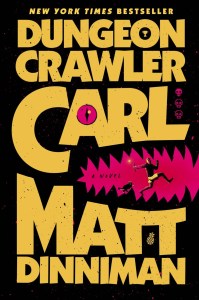
Dungeon Crawler Carl has a creative and interesting premise: take an RPG video game, turn it into a story, and make the whole thing completely ridiculous.
Earth is essentially flattened in an instant, killing anyone who happened to be inside a building or structure. Those lucky (or unlucky) enough to be outside survive, only to be forced into an enormous dungeon where they become “crawlers.” From there, it’s basically a video game come to life: kill monsters, level up, earn achievements, find loot, fight bosses and try not to die.
Carl is quite a gem. He starts as something of an anti-hero — a guy who was treated terribly by his cheating girlfriend Bea and now finds himself running around an alien dungeon with no pants or shoes — but you slowly see just how good of a person he actually is.
The real treat, though, is Donut.
Donut is Bea’s former prize-winning cat who can now talk, and she’s pretty hilarious in her own right. She’s dramatic, obsessed with becoming famous, and more than happy to spill some unfortunate details about Bea’s extracurricular activities to Carl along the way.
I also really enjoyed Mordecai, their assigned safe-room assistant. He’s loyal, smart and becomes a great guide for Carl and Donut. Zev, their PR agent from the very corporation running the dungeon is surprisingly likable too.
There are plenty of genuinely fun moments. The bizarre creatures and bosses are often funny, and some of the best scenes involve Carl figuring out creative ways to beat enemies rather than simply overpowering them. The storyline involving survivors from a retirement home also gives Carl an opportunity to become something more than just another crawler trying to stay alive.
But this is also where the book eventually lost steam for me a bit.
The format gets fairly repetitive: Meet enemy. Fight enemy. Achievement unlocked. Get loot. Check map. Level up. Repeat.
If you play video games, none of that feels particularly groundbreaking. And by the end, I found myself waiting for the larger story to finally go somewhere, and for me it doesn’t really.
There’s no satisfying conclusion to the first book because this is clearly meant to be one continuing adventure. You finish one stage of the dungeon and move on to the next. After an entire book, I wanted at least a little more payoff.
Ultimately, Dungeon Crawler Carl seems much more interested in action, ridiculous situations, R-rated humor and funny dialogue than getting you toward a conclusion. And there’s nothing necessarily wrong with that! It’s entertaining, funny and incredibly easy to read.
I really enjoyed my time with Carl and Donut but I’m just not ready to follow them down another flight of stairs quite yet.
Rating: 7.8/10