By Stephen King
Finished 5/22/26
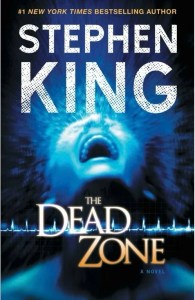
Stephen King’s The Dead Zone feels like one of those books where the concept does a lot of the heavy lifting early on. A man lives with the ability to touch people or objects and suddenly see fragments of the past or future. That’s classic King territory: supernatural, tragic, weirdly human, and rooted in everyday life. And for me, the beginning and ending of this book really worked.
What I liked most about The Dead Zone wasn’t necessarily the “psychic powers” themselves, but the emotional fallout around them. Johnny Smith is one of King’s more grounded protagonists, being very careful about how/when he uses his powers, even though they carry a heavy mental and physical toll. There’s a sadness hanging over him from the beginning, even before a terrible accident and the following coma changes everything in his life. The car crash sequence itself hits hard because of how ordinary and avoidable it feels. King is so good at making catastrophe feel random and deeply personal at the same time.
The relationship between Johnny and Sarah ended up being one of the strongest parts of the book for me, especially their couple origin story. There’s something bittersweet and haunting about how it all fell apart. Their lives drift apart not because of betrayal or lack of love, but because time itself sort of swallows them whole. I actually wish King had kept them together longer as I think the story still could have explored all of its larger themes while letting that relationship breathe more. Their chemistry gave the book a warmth that I missed later on.
The political rise of Greg Stillson is definitely a fascinating thread in the novel. King paints him less like a traditional polished politician and more like some chaotic traveling salesman mixed with a cult leader and pro wrestler. The bikers, the crowds, the cockeyed construction hat, the almost rock-concert atmosphere around him…it all feels strange and theatrical in a way that becomes increasingly unsettling as the story unfolds. King smartly avoids revealing exactly what future horror Johnny sees coming for a long time, which makes Stillson feel like a walking storm cloud throughout the book.
The Wheel of Fortune chapter also really stuck with me. Something about Johnny, Sarah, the carney running the wheel, and that bizarre hot streak of luck gives the whole section this dreamy, ominous energy. King has always been great at writing scenes that feel slightly “off,” like fate quietly rearranging itself in the background while nobody notices yet. That chapter felt like a warning shot for the tragedy to come.
Another underrated piece of the novel is Johnny’s family life, especially the tension between his exhausted father and his deeply religious mother. Vera Smith honestly feels like she wandered in from a darker version of Carrie. Her evangelical obsession and hysterical interpretation of Johnny’s accident create so much emotional pressure in the household. Meanwhile, Johnny’s dad ends up being one of the most sympathetic characters in the entire story. Which is why I was disappointed when he mostly fades from the book later on. After Vera dies, it feels like some of the emotional texture disappears with her. The book loses a little of its spark after that point.
And that’s probably my biggest issue with The Dead Zone overall: the middle section drags. Hard. There’s a long stretch where the momentum just sort of evaporates, and unlike some of King’s longer books, the prose here doesn’t always compensate for it. Usually King can carry you through slower chapters with atmosphere, beautiful small-town observations, or unforgettable character moments. Here, I found myself putting the book down for days at a time without really feeling pulled back in. The novel feels about 100-200 pages longer than it needed to be.
There are also moments where you can feel echoes of other King stories bleeding into this one. The psychic glimpses almost feel like a cousin to the time-bending mechanics of 11/22/63. Stillson carries shades of the populist mob-energy King explores in Under the Dome. Vera’s religious fanaticism recalls Carrie. None of that ruins the book, but it does make The Dead Zone feel slightly less original compared to some of King’s very best work.
That said…the ending absolutely lands (spoiler warning). And it lands in a way that feels deeply “Stephen King.” Johnny believes he may have to become a killer in order to stop Stillson from becoming president. But Stillson’s cowardly act shatters the carefully constructed image he built throughout the novel and changes the path of his history. Johnny dies knowing he altered the future without fully sacrificing his humanity in the process. That’s poetic justice if I’ve ever seen it.
Overall, I liked The Dead Zone more than I loved it. The highs are very high. The emotional core works. The political storyline becomes increasingly compelling. The opening and ending are both fantastic. But the middle stretch really loses steam, and the book never fully reaches the emotional or atmospheric heights of King’s absolute classics for me.
Still very much worth reading, but ranked in the third tier of Stephen King favorability for me.
Rating: 7/10