By: Larry McMurtry
Finished: 8/18/26
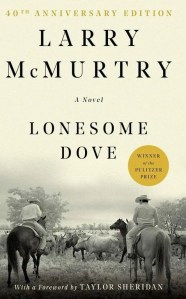
I’m not sure there’s much I can say about Lonesome Dove that hasn’t already been said. It’s one of the best books I’ve ever read.
And for a book that’s 858 pages long, what’s remarkable is how little of it feels wasted. Larry McMurtry fills this thing with so many characters, places, relationships and little adventures that by the end, it feels less like you read a story and more like you spent a long stretch of your life traveling alongside these people.
The characters are what really got me.
Gus McCrae has to be one of my favorite characters I’ve ever encountered in a book. He’s slick, funny, woman-loving, incredibly capable and carries himself with this mystique where you get the sense that nobody is ever really going to get the better of him. Well, except Clara. He can be one mess of a fighter, but he can also be incredibly gentle, especially in his relationship with Lorena. There’s a warmth underneath all the swagger that makes him impossible not to love.
Then there’s Captain Call, who is almost the exact opposite. He barely has a personality on the surface. He’s hard, quiet, honest and completely obsessed with doing what he believes is right. He loves being alone. He understands work and duty much better than he understands people. And yet underneath all of that is this huge contradiction involving Newt, his son, whom he can never quite bring himself to acknowledge. McMurtry never needs to spell out exactly what’s going on inside Call. You just feel it.
That’s true of so many of these characters. Jake Spoon is careless and selfish, making promises to Lorena he probably never seriously intends to keep and continually finding himself mixed up with the wrong people. July Johnson starts out as a sheriff pursuing Jake and seems to be part of an almost completely different story. Other characters disappear for huge stretches of the book. At times you wonder how all these threads could possibly be connected.
And then, slowly, they are.
That might be my favorite thing about the construction of Lonesome Dove. The world feels enormous. People seem impossibly far away from one another, living their own lives and having their own adventures, and then their paths cross in ways that feel completely natural. Nobody exists simply because the plot needs them to.
There’s also just an endless amount of stuff that happens. A cattle drive across the country could easily become repetitive, but McMurtry constantly interrupts the quiet with these little bursts of danger, tragedy, humor and absurdity. There are outlaws and Indians and storms and shootings and a bull that battles a grizzly bear. There are moments of horrible violence followed by long stretches of dusty cowboys riding across an almost empty landscape.
And somehow, all of it is beautiful.
That’s another thing I loved about McMurtry’s writing. He can make the smallest, most uneventful moments feel as important as the big ones. One of my favorite passages in the entire book is just Gus getting up early, making biscuits outside and watching the sun come up. McMurtry writes:
“It was tribute enough to sunrise that it could make even chaparral bushes look beautiful.”
It’s just a perfect line. A few sentences earlier, he describes the sun rising over the landscape until it “lifted clear, like an immense coin.” There’s no action here. Nothing important to the plot is happening. Gus is making breakfast, enjoying the morning and reading a little from the Bible while his biscuits brown. But these quiet moments are part of what makes the world of Lonesome Dove feel so real. McMurtry lets you live there for a while.
And that beauty is constantly sitting next to brutality. The distances are enormous. Death can come from an animal, a river, another person or simple bad luck. The treatment of women is often awful, and prostitution seems to be one of the few options available to many of them. Violence is always nearby. There’s a sense throughout the book that civilization barely exists and that the people traveling through this country are largely responsible for keeping themselves alive.
But I don’t think Lonesome Dove is really about cowboys or the Wild West.
It’s about people.
It’s about friendship and loneliness and regret. It’s about the strange bonds people form when they go through something difficult together. It’s about men who can survive almost anything physically while being completely incapable of saying what they actually feel. And there’s this sadness hanging over so much of the book, even during its funniest and most adventurous moments.
That sadness becomes especially powerful because, after absorbing the minute details, these people feel real. When something happens to one of them, you don’t just register it as another plot development. You feel like you lost somebody you knew.
That was certainly true for me with Gus.
By the end, I didn’t want to leave these characters. That’s probably the highest compliment I can give a book this long. Instead of being relieved to finally finish, I was sad there weren’t more.
One of the best-written books I’ve ever read, cover to cover, and one of the easiest ratings I’ve given. It doesn’t hurt that while nearing the end, I spent time riding horses with my wife through a Washington forest—truly bringing this to life.
Rating: 10/10